 Add to Chrome
 Add to Firefox
 Add to Edge
DisPlace: Discriminative Place Projections for Multi-Reference Visual Place Recognition
May 29, 2026
A key challenge in Visual Place Recognition (VPR) is matching query images against reference maps captured under diverse environmental conditions and viewpoints. While multiple reference traversals improve robustness, existing fusion strategies either aggregate references uniformly or rely on heuristic selection, without distinguishing descriptor variations that preserve stable place identity from those caused by changing conditions or viewpoints. In this paper, we propose DisPlace, a multi-reference VPR framework that fuses multiple reference descriptors into a single compact and discriminative place representation. DisPlace formulates descriptor fusion as a generalized eigenvalue problem that maximizes between-place separability while suppressing within-place variation across references, rather than preserving overall descriptor variance. Unlike existing multi-reference fusion methods, DisPlace exploits variation across reference traversals to identify which linear combinations of descriptor dimensions preserve place identity and which capture condition- or viewpoint-specific variation. We evaluate DisPlace on Oxford RobotCar, Nordland, Pittsburgh30k, and Google Landmarks v2 across six state-of-the-art VPR descriptors. DisPlace outperforms seven multi-reference baselines in 49 out of 54 appearance-varying conditions, consistently improves descriptor-level fusion performance under viewpoint and unstructured settings, and requires less storage during inference than all compared fusion methods.

Déjà View: Looping Transformers for Multi-View 3D Reconstruction
May 28, 2026Recent feed-forward 3D reconstruction transformers have scaled to over a billion parameters, following the broader trend of increasing model capacity in computer vision. Yet emerging evidence suggests that contiguous transformer layers often behave like repeated applications of similar operations, and multi-view reconstruction transformers refine their predictions progressively across decoder depth. We posit that model depth partially buys iteration, paid for inefficiently in unique parameters, and instead make that iteration explicit in architecture. Our model, DéjàView, applies a single looped transformer block recurrently to per-view features for K refinement steps. Trained once, it exposes K as an inference-time compute knob, matching or outperforming substantially larger feed-forward baselines across five reconstruction benchmarks spanning indoor, outdoor, object-centric, and driving scenes, while using a fraction of their parameters and comparable or lower compute. Importantly, the same looped block formulation outperforms an otherwise identical variant with independent per-step parameters under matched training data and compute, suggesting that explicit iteration is not merely a compute-efficient substitute for capacity but a stronger inductive bias for multi-view 3D reconstruction.
ArtiFixer: Enhancing and Extending 3D Reconstruction with Auto-Regressive Diffusion Models
Feb 28, 2026Per-scene optimization methods such as 3D Gaussian Splatting provide state-of-the-art novel view synthesis quality but extrapolate poorly to under-observed areas. Methods that leverage generative priors to correct artifacts in these areas hold promise but currently suffer from two shortcomings. The first is scalability, as existing methods use image diffusion models or bidirectional video models that are limited in the number of views they can generate in a single pass (and thus require a costly iterative distillation process for consistency). The second is quality itself, as generators used in prior work tend to produce outputs that are inconsistent with existing scene content and fail entirely in completely unobserved regions. To solve these, we propose a two-stage pipeline that leverages two key insights. First, we train a powerful bidirectional generative model with a novel opacity mixing strategy that encourages consistency with existing observations while retaining the model's ability to extrapolate novel content in unseen areas. Second, we distill it into a causal auto-regressive model that generates hundreds of frames in a single pass. This model can directly produce novel views or serve as pseudo-supervision to improve the underlying 3D representation in a simple and highly efficient manner. We evaluate our method extensively and demonstrate that it can generate plausible reconstructions in scenarios where existing approaches fail completely. When measured on commonly benchmarked datasets, we outperform existing all existing baselines by a wide margin, exceeding prior state-of-the-art methods by 1-3 dB PSNR.
Automatic Map Density Selection for Locally-Performant Visual Place Recognition
Feb 25, 2026A key challenge in translating Visual Place Recognition (VPR) from the lab to long-term deployment is ensuring a priori that a system can meet user-specified performance requirements across different parts of an environment, rather than just on average globally. A critical mechanism for controlling local VPR performance is the density of the reference mapping database, yet this factor is largely neglected in existing work, where benchmark datasets with fixed, engineering-driven (sensors, storage, GPS frequency) sampling densities are typically used. In this paper, we propose a dynamic VPR mapping approach that uses pairs of reference traverses from the target environment to automatically select an appropriate map density to satisfy two user-defined requirements: (1) a target Local Recall@1 level, and (2) the proportion of the operational environment over which this requirement must be met or exceeded, which we term the Recall Achievement Rate (RAR). Our approach is based on the hypothesis that match patterns between multiple reference traverses, evaluated across different map densities, can be modelled to predict the density required to meet these performance targets on unseen deployment data. Through extensive experiments across multiple VPR methods and the Nordland and Oxford RobotCar benchmarks, we show that our system consistently achieves or exceeds the specified local recall level over at least the user-specified proportion of the environment. Comparisons with alternative baselines demonstrate that our approach reliably selects the correct operating point in map density, avoiding unnecessary over-densification. Finally, ablation studies and analysis evaluate sensitivity to reference map choice and local space definitions, and reveal that conventional global Recall@1 is a poor predictor of the often more operationally meaningful RAR metric.
Long-Term Multi-Session 3D Reconstruction Under Substantial Appearance Change
Feb 24, 2026Long-term environmental monitoring requires the ability to reconstruct and align 3D models across repeated site visits separated by months or years. However, existing Structure-from-Motion (SfM) pipelines implicitly assume near-simultaneous image capture and limited appearance change, and therefore fail when applied to long-term monitoring scenarios such as coral reef surveys, where substantial visual and structural change is common. In this paper, we show that the primary limitation of current approaches lies in their reliance on post-hoc alignment of independently reconstructed sessions, which is insufficient under large temporal appearance change. We address this limitation by enforcing cross-session correspondences directly within a joint SfM reconstruction. Our approach combines complementary handcrafted and learned visual features to robustly establish correspondences across large temporal gaps, enabling the reconstruction of a single coherent 3D model from imagery captured years apart, where standard independent and joint SfM pipelines break down. We evaluate our method on long-term coral reef datasets exhibiting significant real-world change, and demonstrate consistent joint reconstruction across sessions in cases where existing methods fail to produce coherent reconstructions. To ensure scalability to large datasets, we further restrict expensive learned feature matching to a small set of likely cross-session image pairs identified via visual place recognition, which reduces computational cost and improves alignment robustness.
Quantile Transfer for Reliable Operating Point Selection in Visual Place Recognition
Feb 04, 2026Visual Place Recognition (VPR) is a key component for localisation in GNSS-denied environments, but its performance critically depends on selecting an image matching threshold (operating point) that balances precision and recall. Thresholds are typically hand-tuned offline for a specific environment and fixed during deployment, leading to degraded performance under environmental change. We propose a method that, given a user-defined precision requirement, automatically selects the operating point of a VPR system to maximise recall. The method uses a small calibration traversal with known correspondences and transfers thresholds to deployment via quantile normalisation of similarity score distributions. This quantile transfer ensures that thresholds remain stable across calibration sizes and query subsets, making the method robust to sampling variability. Experiments with multiple state-of-the-art VPR techniques and datasets show that the proposed approach consistently outperforms the state-of-the-art, delivering up to 25% higher recall in high-precision operating regimes. The method eliminates manual tuning by adapting to new environments and generalising across operating conditions. Our code will be released upon acceptance.
Robust Scene Coordinate Regression via Geometrically-Consistent Global Descriptors
Dec 19, 2025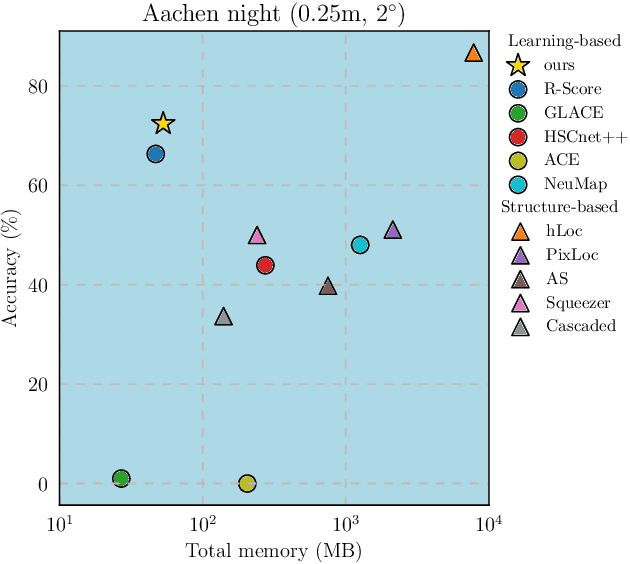
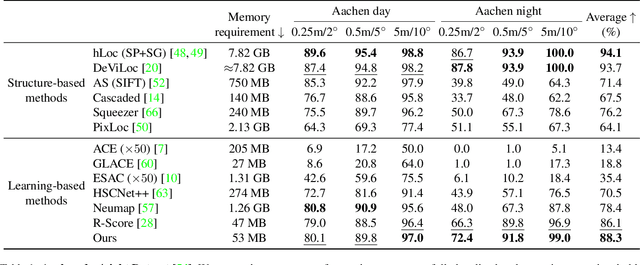
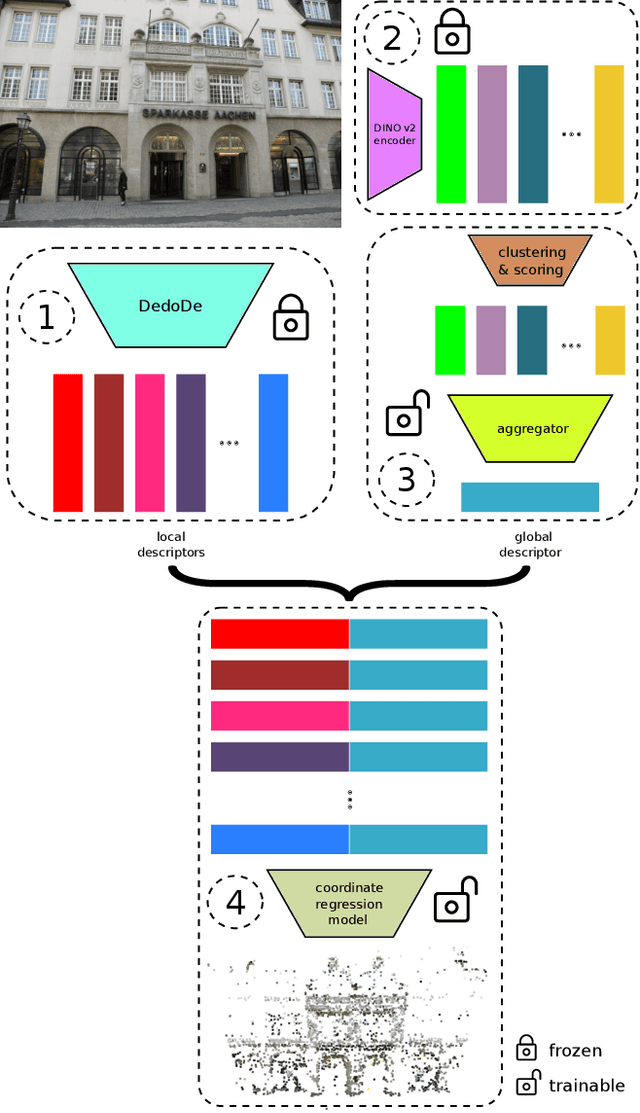
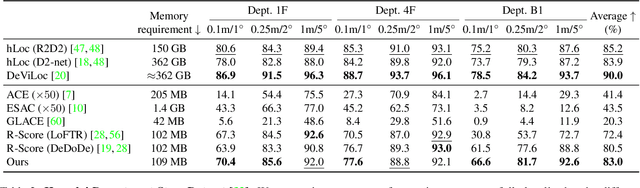
Recent learning-based visual localization methods use global descriptors to disambiguate visually similar places, but existing approaches often derive these descriptors from geometric cues alone (e.g., covisibility graphs), limiting their discriminative power and reducing robustness in the presence of noisy geometric constraints. We propose an aggregator module that learns global descriptors consistent with both geometrical structure and visual similarity, ensuring that images are close in descriptor space only when they are visually similar and spatially connected. This corrects erroneous associations caused by unreliable overlap scores. Using a batch-mining strategy based solely on the overlap scores and a modified contrastive loss, our method trains without manual place labels and generalizes across diverse environments. Experiments on challenging benchmarks show substantial localization gains in large-scale environments while preserving computational and memory efficiency. Code is available at \href{https://github.com/sontung/robust\_scr}{github.com/sontung/robust\_scr}.
ReMoSPLAT: Reactive Mobile Manipulation Control on a Gaussian Splat
Dec 10, 2025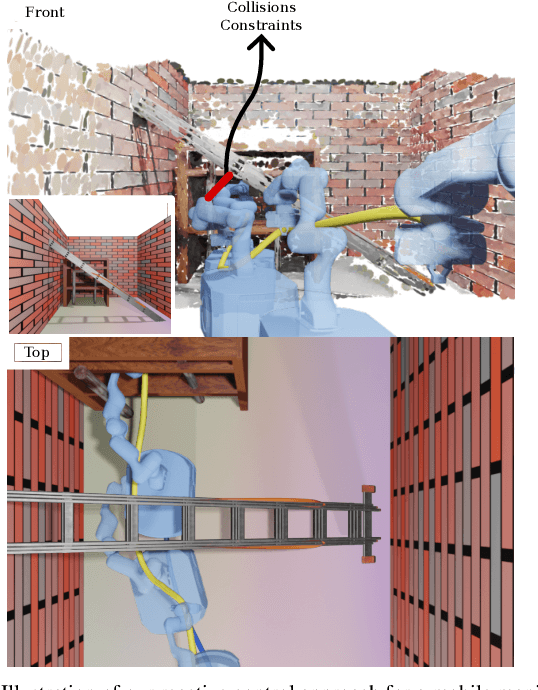
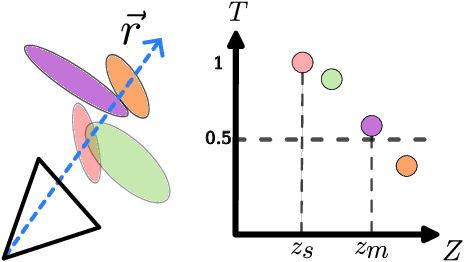
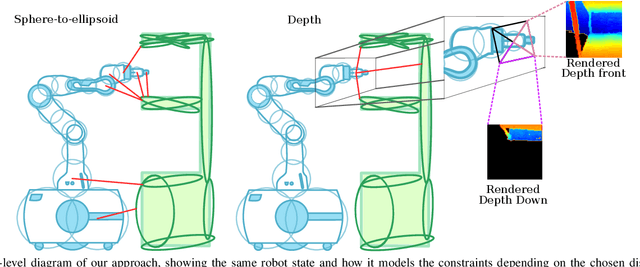
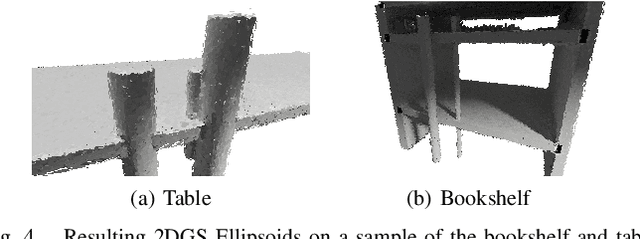
Reactive control can gracefully coordinate the motion of the base and the arm of a mobile manipulator. However, incorporating an accurate representation of the environment to avoid obstacles without involving costly planning remains a challenge. In this work, we present ReMoSPLAT, a reactive controller based on a quadratic program formulation for mobile manipulation that leverages a Gaussian Splat representation for collision avoidance. By integrating additional constraints and costs into the optimisation formulation, a mobile manipulator platform can reach its intended end effector pose while avoiding obstacles, even in cluttered scenes. We investigate the trade-offs of two methods for efficiently calculating robot-obstacle distances, comparing a purely geometric approach with a rasterisation-based approach. Our experiments in simulation on both synthetic and real-world scans demonstrate the feasibility of our method, showing that the proposed approach achieves performance comparable to controllers that rely on perfect ground-truth information.
Going Places: Place Recognition in Artificial and Natural Systems
Nov 18, 2025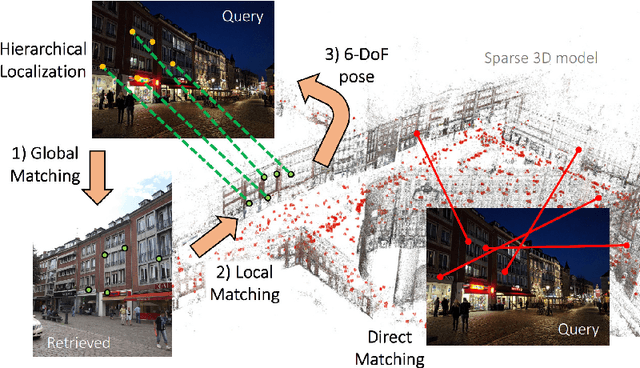
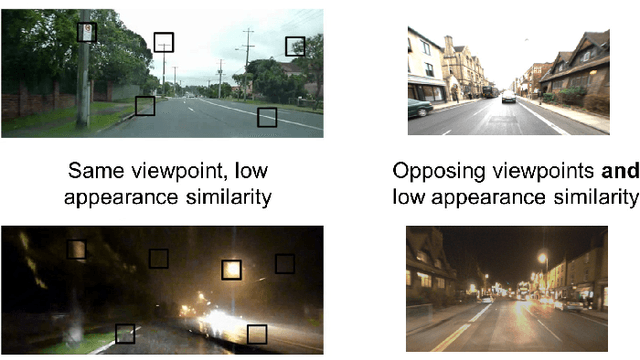
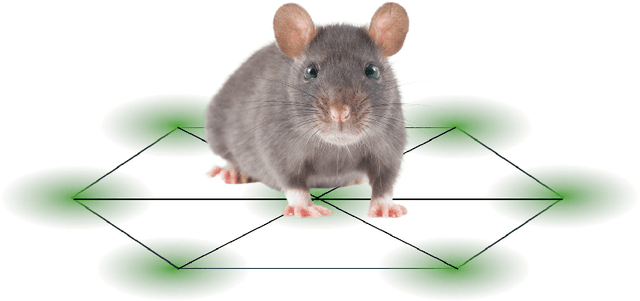
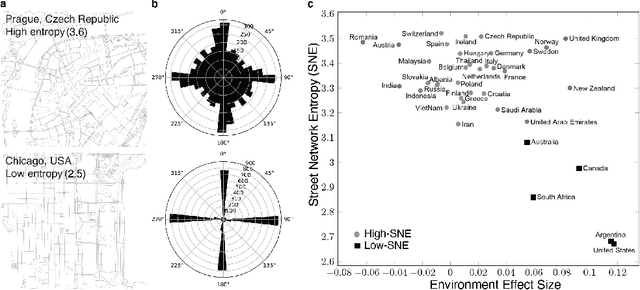
Place recognition, the ability to identify previously visited locations, is critical for both biological navigation and autonomous systems. This review synthesizes findings from robotic systems, animal studies, and human research to explore how different systems encode and recall place. We examine the computational and representational strategies employed across artificial systems, animals, and humans, highlighting convergent solutions such as topological mapping, cue integration, and memory management. Animal systems reveal evolved mechanisms for multimodal navigation and environmental adaptation, while human studies provide unique insights into semantic place concepts, cultural influences, and introspective capabilities. Artificial systems showcase scalable architectures and data-driven models. We propose a unifying set of concepts by which to consider and develop place recognition mechanisms and identify key challenges such as generalization, robustness, and environmental variability. This review aims to foster innovations in artificial localization by connecting future developments in artificial place recognition systems to insights from both animal navigation research and human spatial cognition studies.
Pixi: Unified Software Development and Distribution for Robotics and AI
Nov 06, 2025The reproducibility crisis in scientific computing constrains robotics research. Existing studies reveal that up to 70% of robotics algorithms cannot be reproduced by independent teams, while many others fail to reach deployment because creating shareable software environments remains prohibitively complex. These challenges stem from fragmented, multi-language, and hardware-software toolchains that lead to dependency hell. We present Pixi, a unified package-management framework that addresses these issues by capturing exact dependency states in project-level lockfiles, ensuring bit-for-bit reproducibility across platforms. Its high-performance SAT solver achieves up to 10x faster dependency resolution than comparable tools, while integration of the conda-forge and PyPI ecosystems removes the need for multiple managers. Adopted in over 5,300 projects since 2023, Pixi reduces setup times from hours to minutes and lowers technical barriers for researchers worldwide. By enabling scalable, reproducible, collaborative research infrastructure, Pixi accelerates progress in robotics and AI.